Ice-Out on Moosehead: 178 Years of Watching and Waiting
Every spring, people around the region — and well beyond it — start watching Moosehead Lake. They are waiting for the ice to go out. They always have been.
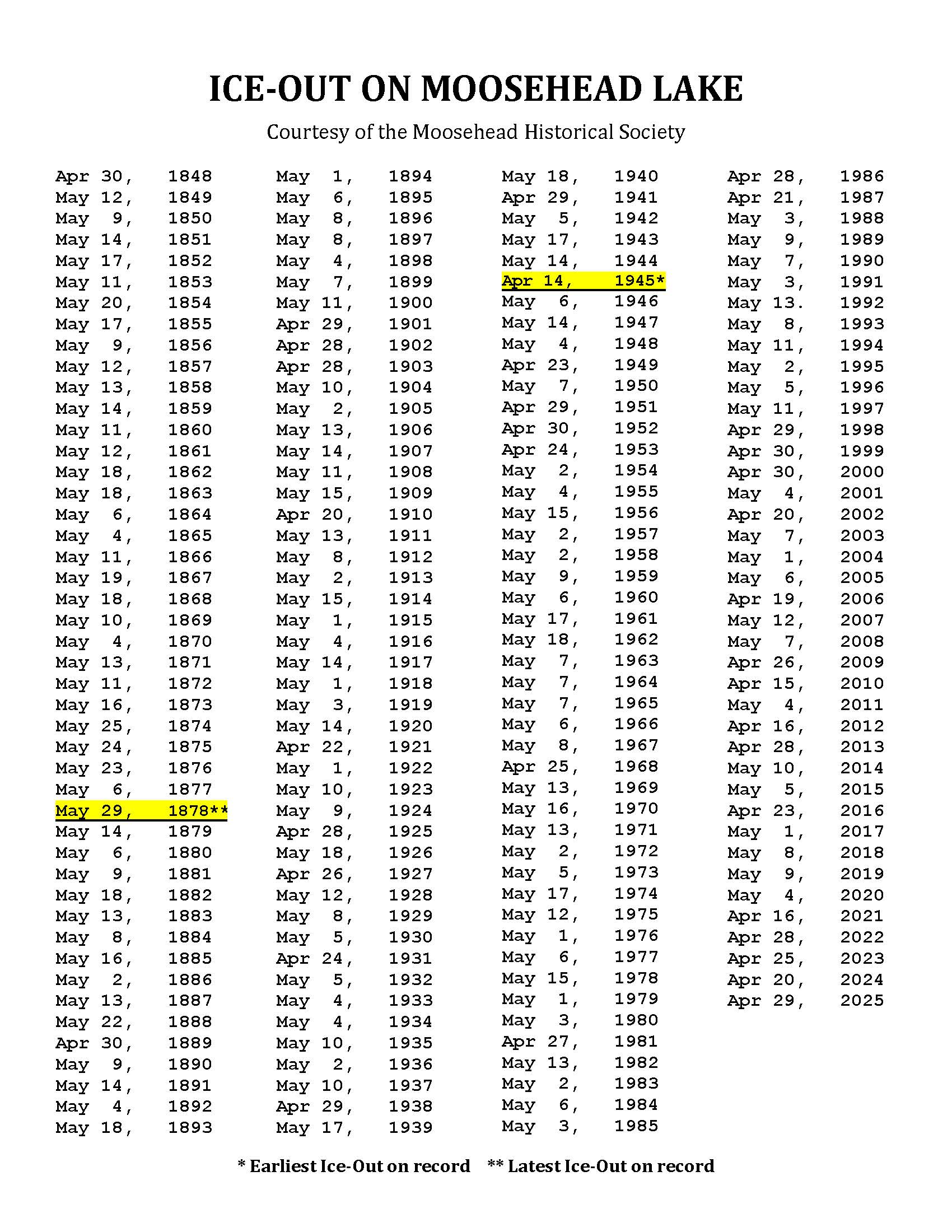
Moosehead Lake has one of the longest unbroken ice-out records of any lake in North America — 178 consecutive years, going back to 1848. The credit for that belongs above all to Sanders Store in Greenville. D.T. Sanders came to Greenville at age 14 to apprentice under pioneer businessman John Eveleth, and what he built — D.T. Sanders & Son, the Old Country Store on Main Street — became one of the most durable business stories in the history of the region. Four generations of the Sanders family ran the store for 125 years, and through all of it they kept the ice-out record. Various organizations carried it forward after the store closed in 1981, and the Moosehead Historical Society has maintained it for the past few years. But it is the Sanders family that built this record. Without them, we would have nothing.
Ice-out is the moment when Moosehead Lake is declared open to navigation — when a clear channel runs the full 40 miles from Greenville at the south end to Northeast Carry at the north. It is not the last piece of ice on the lake. It is the moment the lake is passable.
The numbers tell a clear story. The earliest ice-out on record is April 14, 1945. The latest is May 29, 1878. The long-term average across all 178 years is May 5. But that average has shifted steadily. In the 1800s, the average was May 11. In the 1900s, it was May 4. So far in this century, it is April 28 — two full weeks earlier than the 19th century average. In the entire second half of the 1800s, only two ice-outs came in April. So far this century, half of them have. The 2025 ice-out was April 29.
To understand why this date has mattered so much for so long, you need to understand what ice-out meant to two very different groups of people — and how completely both depended on the same lake.
For the logging industry, ice-out was the starting gun. Knowing when the lake opened gave mill operators and timber buyers downriver a reliable sense of when their wood would arrive — and they planned accordingly. Logs were stacked along streams, rivers, and the shore of the lake all winter, waiting for the ice to go out and the spring freshets to carry them down. When the water rose, the drives began. On the lake, logs were gathered into rafts — sometimes covering more than 20 acres — and towed behind a steamer to the East Outlet, then driven along the Kennebec River to mills as far south as Waterville, Augusta and Bath. That drive continued every spring until 1975. A lot of people in this community watched the last one.
At the same time, a very different economy was watching the same date just as closely.
For sportsmen and the tourism economy, ice-out opened the fishing season. When Kineo became a major resort destination in the 1860s, anglers were watching the date just as closely as the loggers — Mainers, certainly, but also the wealthy sports arriving from Boston and New York who were putting Moosehead on the national map. Once the railroad reached Greenville in 1884, sports could make the trip from Boston in a single day, and they came in numbers the region had never seen. An 1886 dispatch in the Kennebec Journal captures the rhythm perfectly: the ice left Moosehead on May 2, and a large party of sportsmen left Bangor for the lake the very next morning.
The large steamboats on the lake served both worlds, and ice-out set both in motion. First came the log drives — the boats would spend weeks towing massive rafts of timber across the lake to the East Outlet. Once the drives wound down, they shifted to carrying sports to the resorts and fishing camps for the summer season. The Katahdin, built in 1914 and the only vessel of that era still on Moosehead, takes her cue from ice-out just as she always has. When the lake opens, she gets ready for the season — and for those who know her history, she is a living reminder of everything this lake once was.
After World War II, fishing at Moosehead drew national attention. The lake was producing exceptional landlocked salmon and brook trout, and publishers with personal ties to the region made sure their readers knew it. Guy Gannett, who owned a retreat on Forest Park, an island in Lily Bay, and who owned the Portland Press Herald, gave Moosehead fishing prominent coverage year after year. The Bangor Daily News did the same, and went a step further — their annual ice-out guessing contest became a statewide event, drawing nearly 15,000 entries in 1955 from across the country and several foreign nations.
Because the lake runs nearly 40 miles from Greenville to Northeast Carry, determining ice-out has always required someone with a view of the whole thing. In the early days that was almost certainly the steamship operators, the men who knew the lake best and had the most at stake. By the 1950s, state wardens were making the call from the air, flying over Sugar and Deer Islands to watch for the moment the channel cleared. Through the 1960s, 70s, and 80s, Folsom’s Air Service of Greenville took on that role. Pilots such as Dick Folsom, Charlie Coe, and Max Folsom made the annual flight season after season, and when Folsom landed and said the lake was clear, it was official.
By the 1990s, Roger Currier of Currier’s Flying Service had taken on the responsibility, flying his single-engine Beaver from Greenville to Northeast Carry each spring. He and his wife Sue monitored ice conditions closely each spring before he made the flight, and they treated the call as the serious public trust it was. Roger Currier passed away in 2021. His chief pilot, Roger Paradise, carries on the tradition today, posting daily updates on Facebook as conditions develop and putting out the word the moment the channel is clear.
Year after year, ice-out on Moosehead graced the front pages of newspapers across the region — the Boston Globe, the Lewiston Evening Journal, the Bangor Daily News, and many others. That was not an accident. When an entire region’s economy depended on one question — when will the lake open — the answer was news.
The stakes have changed. The date has changed. But every spring, people are still looking out at Moosehead — and waiting.
The Moosehead Historical Society is located in Greenville, Maine, at the southern end of the lake. We collect, preserve, and share the history of the entire Moosehead region — the people, the places, and the stories that made it what it is. The ice-out record is just one small part of what lives here. If you have never stopped in, this is a good time to start. We would love to see you.