Moosehead Then & Now: August 1976
August 1976 found America enjoying the final weeks of its Bicentennial summer. Elton John and Kiki Dee’s “Don’t Go Breaking My Heart” held the top spot on the music charts throughout the month, while The Omen remained one of the summer’s most talked-about movies. Here in the Moosehead region, life continued at its familiar summer pace. The pages of the Moosehead Gazette were filled with sporting camps, community suppers, town projects, local craftsmen, and neighbors helping neighbors. There was no single headline that defined the month. What struck me instead was how many of those seemingly ordinary stories are still unfolding today.
A Century at Maynard’s-in-Maine
One of the month’s feature stories introduced readers to Roger Maynard, who was carrying on the tradition established by his father, Walter, at Maynard’s-in-Maine in Rockwood. Walter had established the camps in 1919, and by 1976 generations of fishermen, hunters, and vacationing families had found their way there for the kind of North Woods experience that made the Moosehead region famous. Roger was preserving not only a successful business, but also a reputation for hospitality that his father had built over many years.
Roger operated Maynard’s for more than forty years before his death in 1996 — his son Bill and Bill’s wife, Gail, then carried the camps forward together. After Bill died in 2024, Gail continued through the final period of Maynard family ownership. The property was sold in 2025, bringing to a close more than a century in the same family.
Yet the story did not end there. Maynard’s has been back in the news this summer: on July 8, Maine’s Land Use Planning Commission voted unanimously to approve rezoning the property into a conforming recreational lodging use — the first step toward the new owners’ plans to restore and redevelop the site. Reopening the restaurant will take considerably more work, including renovations, additional permitting, and state licensing, but the intention is to preserve the sporting-camp character that made the place so well known. Reading the 1976 article today is a reminder that some of Moosehead’s best-known places have survived not because they never changed, but because each generation found a way to carry them forward.
A Tribute to Carol Stirling
While going through the August newspapers, another item caused me to stop for a moment. It was not a front-page headline or a long feature story. It was a small advertisement for West Branch Pond Camps announcing its Thursday-night prime rib dinner. Andy and Carol Stirling were listed as the proprietors.
The advertisement struck me because Carol had passed away only days before I found it.
Carol’s connection to West Branch Pond Camps began long before the 1976 advertisement appeared. She was three years old when her parents, Clift and Connie Kealiher, took over the camps from her grandparents. Her childhood was divided between summers at West Branch and winters in Greenville, where she graduated with the Class of 1965 before attending the University of Maine.
After marrying Andy Stirling, Carol returned to Maine with him and their young family in 1974 to become the next generation at West Branch Pond Camps. Their son Eric was born the following year. Carol spent the remainder of her working life at the camps before retiring to Greenville in 2004.
Anyone who knew Carol understood that she was much more than a name at the bottom of an advertisement. She loved the Maine woods, animals, the changing seasons, and the work of welcoming people to the camps — known for her quick wit and laughter, but also for the things she made with her own hands. Her apple pie and anadama bread became local favorites and were recognized in food and travel publications. She preferred cooking from scratch and remained suspicious of many labor-saving devices.
The Thursday-night prime rib dinners advertised in August 1976 have never disappeared. Every summer, on Thursday evenings in July, August, and September, people still make the trip to West Branch Pond Camps. Today, Carol and Andy’s son Eric and his wife, Mildred Kennedy-Stirling, carry the tradition forward. Fifty years have passed and much has changed around Moosehead, but on Thursday nights in summer, the prime rib dinner continues. Some traditions do not need to be reinvented. They simply need someone willing to keep them going.
The Biggest Fair Ever
Another August story reported what the Gazette proudly called the “Biggest Fair Ever.” The Ready Workers had planned two seatings for their turkey-pie supper at Greenville’s Community House. Demand was so great that they added a third. More than 230 meals were served, tables of food and handmade goods were nearly emptied, and the event raised more than $1,600.
The Gazette saw the fair as evidence that people still cared about the old Community House and believed it could again become an important part of Greenville’s future. At the time, no one could have known exactly what that future would look like.
Today, the same building is the Center for Moosehead History and the year-round home of the Moosehead Historical Society. Visitors come through its doors for exhibits, research, public programs, meetings, and community events. The building survived because generation after generation believed it was worth the effort — the Ready Workers’ fair in August 1976 was one part of that longer story.
The Spruce Street Extension
Some of the most interesting items from fifty years ago occupied only a few inches of newspaper space.
Buried in the town office notes was a brief report that Greenville’s maintenance crew was working on the Spruce Street extension. The road was being widened, drainage was being installed, and the improved section was to be paved. It was the kind of routine public-works item most readers probably glanced over before turning the page.
Spruce Street is once again making news. Paving is now underway within a new housing development expected to be completed by 2027. Plans call for as many as twenty-nine homes, including duplexes, townhouses, multifamily buildings, and single-family houses. The project is intended to help meet the region’s housing needs, support the local workforce, and make it easier for young families to remain in or move to Greenville.
The 1976 road work and today’s housing project are separated by half a century, but they are part of the same continuing question: how does a small town prepare for its future? Sometimes an item that looked ordinary at the time turns out to have a very long life.
A Master Canoe Builder
The August 27 issue also introduced readers to Rockwood canoe builder Fred Reckards. The Gazette called him a master at his craft, and that description was well deserved. Fred built fifteen- and twenty-foot cedar canoes around forms made by Greenville craftsman Fred Templeton during the 1930s and 1940s. He used thin cedar planking, steamed the ribs into shape, and individually set the brass-headed canoe tacks. The canoes were then carefully sanded, fiberglassed, and varnished.
Fred said that a twenty-foot canoe required about two weeks of work. Many were built to order and sold as quickly as he could finish them. Earlier in 1976, he had been invited to display his work at a Smithsonian festival in Washington, but a fire had destroyed his inventory of seven canoes and prevented him from attending.
Fred Reckards canoes remain prized possessions today — valued not only because they are beautiful and useful boats, but because each one represents a traditional craft practiced with patience and skill. Fred also served during the Korean War, and his son Stephen later served in Vietnam. This year Stephen was among the veterans honored posthumously in Washington through the Vietnam Veterans Memorial Fund’s In Memory Program. His wife, Rita, and daughter, Amy, attended the ceremony.
The Finest Dog Catcher Around
One of my favorite pieces from the month carried the headline “Greenville Dog Catcher Finest Around.” It featured Edward Lambert, although calling Ed simply the dog catcher hardly told the whole story.
Before coming to Greenville, Ed had lived in Dexter, where he worked in area woolen mills and at Fay-Scott. He later served as a ranger with the Maine State Forestry Service. In Greenville he worked for many years as a constable, and by 1976 he had also been the town’s dog catcher for about three years.
The Gazette found every available space in Ed’s small kennel occupied by dogs, puppies, and cats. Some had been abandoned. Others had been injured or simply needed a temporary home. Ed knew the animals, talked to them, found homes for them, and cared for those no one else wanted. He refused to kill healthy animals after the town’s required holding period — instead, he continued feeding them, often at his own expense, while trying to place them with families. Local merchant Llewellyn “Gus” Wortman helped by providing meat scraps and trimmings.
Ed did not appear to think any of this was remarkable. He loved animals and children, and he did what needed to be done.
Ed Lambert died in 1988 at the age of seventy-seven. He was not a famous man, yet many people still remember him, and the 1976 article explains why. Every community depends upon people who quietly take responsibility for things others overlook. Their work may seem small at the time, but their kindness becomes part of the character of the place.
As I finished reading the August 1976 newspapers, I realized that the month’s most lasting stories were not the largest headlines. They were the stories that never really ended: a sporting camp beginning another chapter, a family meal still served every Thursday night, a building preserved for another generation, a road continuing to shape Greenville’s growth, a craftsman whose canoes are still treasured, and a quiet public servant remembered for his compassion.
History is often measured by wars, elections, disasters, and major public events. Those stories deserve their place. But the history of a community is also found in the traditions people keep, the places they refuse to give up on, and the men and women who spend their lives doing useful work without expecting much attention. The August 1976 Gazette reminds us that what looks ordinary in the moment may, with the passage of time, become the story worth remembering.
Looking Back, Looking Forward
Next month, we’ll look back at September 1976 — the largest seaplane fly-in ever held in the country descending on Greenville’s cove, with nearly ninety planes and more than 150 pilots taking part. Buffalo Bill McKelvy turned another year older with an uproarious birthday party on Gingerbread Hill, while longtime Greenville Water Company manager Ernest Harrington retired after twenty-three years on the job. And a new teacher arrived at Greenville High School to start the year.
This column is brought to you by the Moosehead Historical Society, where every season brings new stories to uncover, preserve, and share. We’re here to keep Moosehead’s history alive — one memory at a time. You can support our work by becoming a member at mooseheadhistory.org.
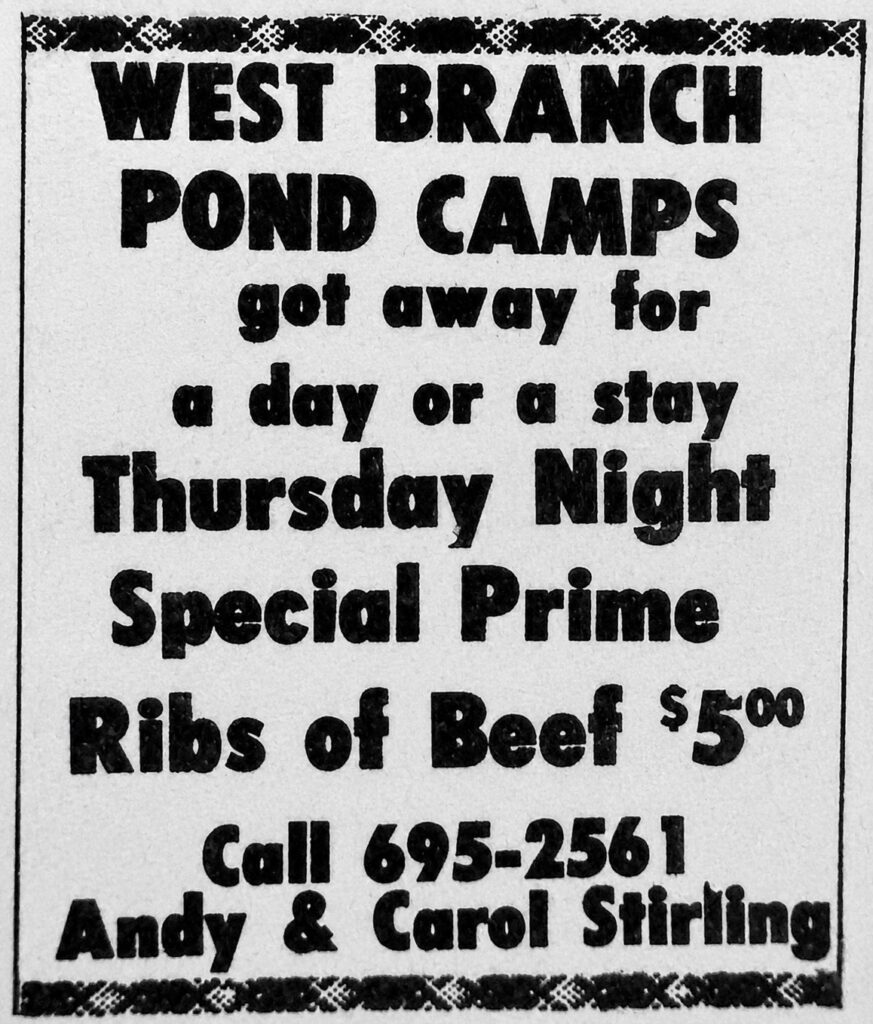
West Branch Pond Camps advertisement, August 1976, listing Andy and Carol Stirling as proprietors — the same Thursday-night prime rib dinner still served at the camps today.
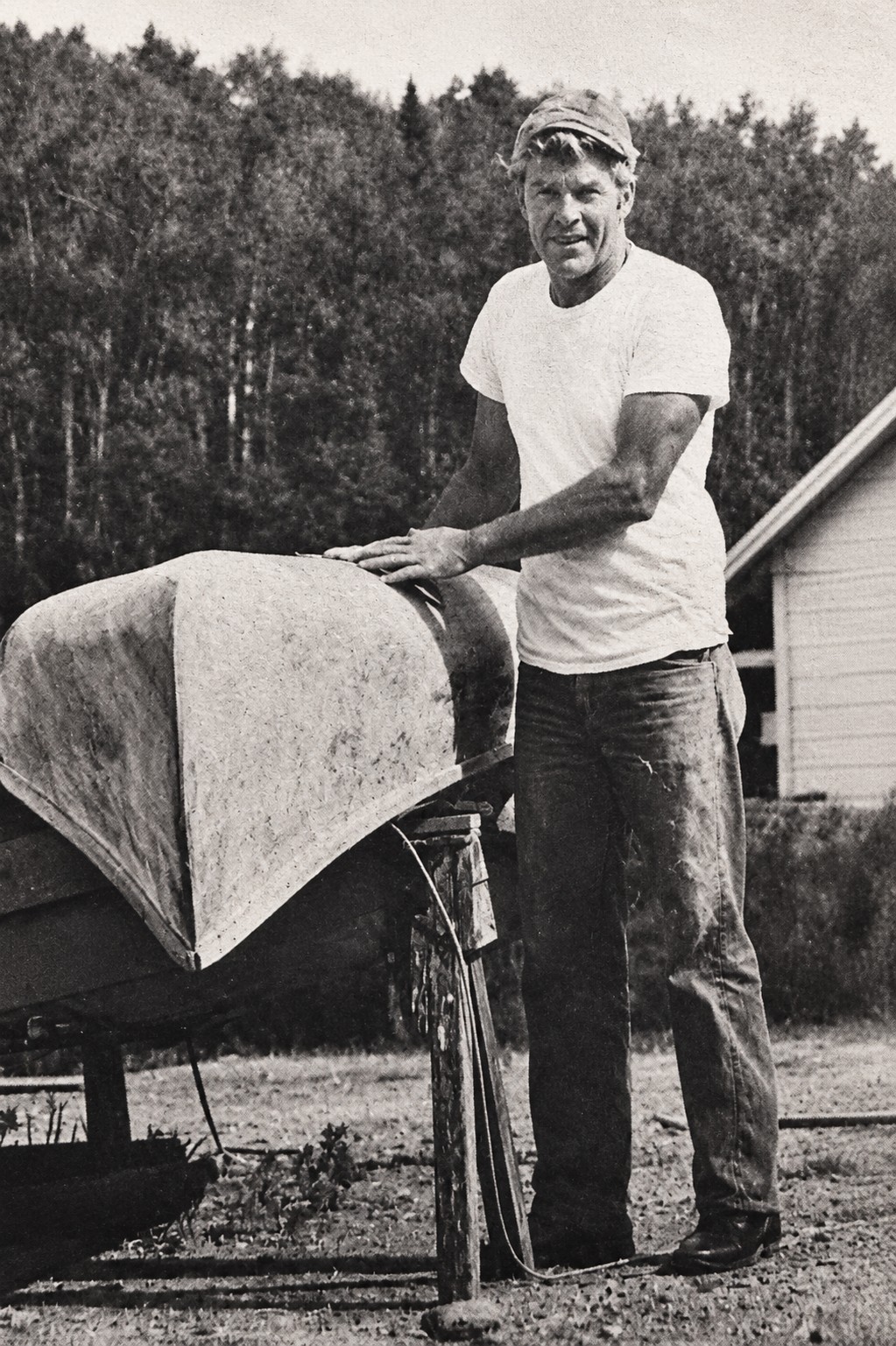
Fred Reckards outside his shop in Rockwood, 1976, with one of his hand-built cedar canoes. Each one took about two weeks to make — and decades later, they’re still treasured for it.
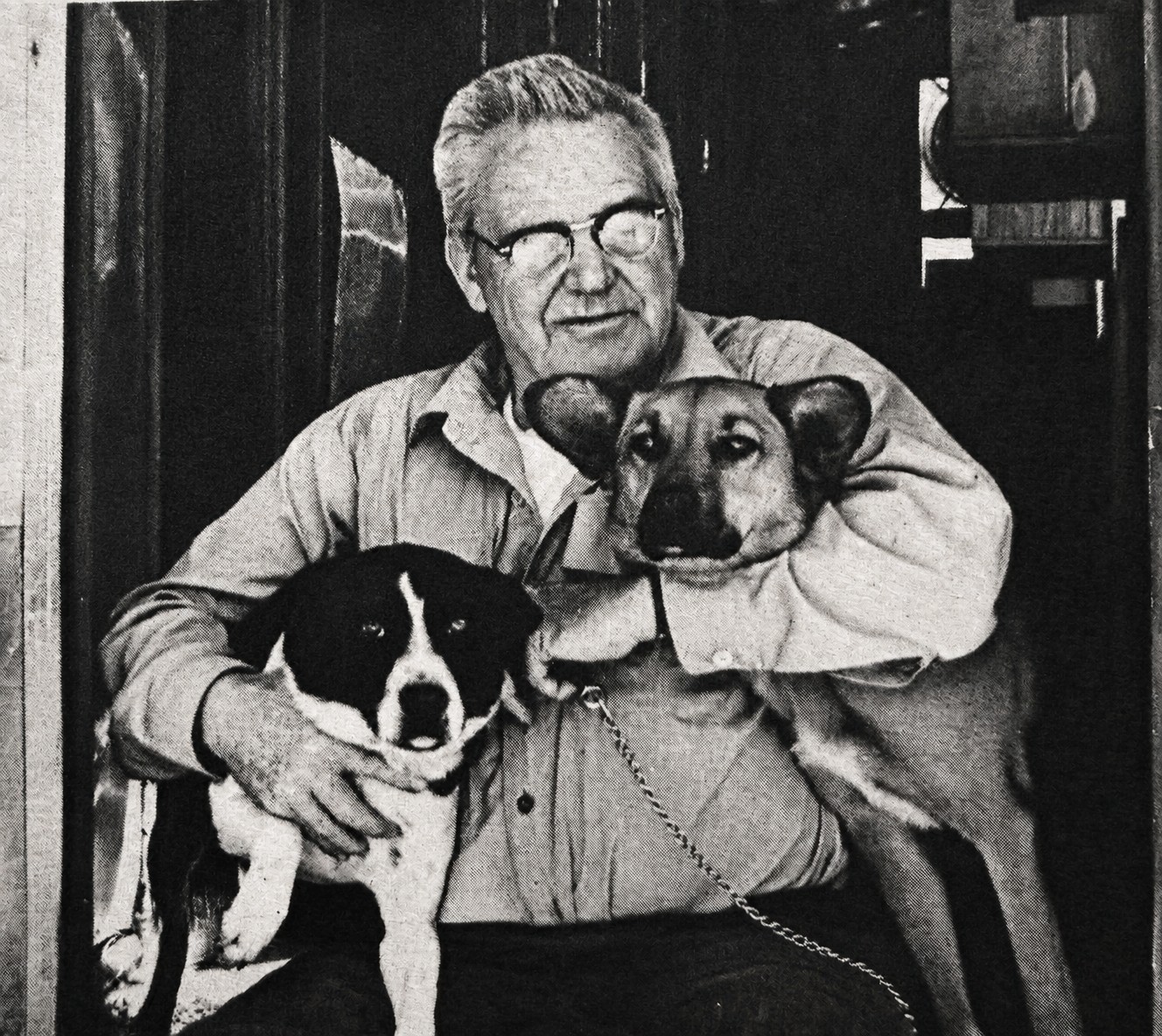
Ed Lambert and two of the animals nobody else wanted, 1976. He fed them at his own expense and rarely gave up on finding them a home.