Moosehead Then & Now: February 1976
February 1976 arrived with the country caught between celebration and uncertainty. The Winter Olympics were underway in Innsbruck, Austria, where Dorothy Hamill’s skating — and her haircut — made her a household name. A new strain of swine flu had been detected at Fort Dix, prompting national concern. The Bicentennial year was in full swing, and Barry Manilow’s “I Write the Songs” was holding steady near the top of the charts. It was a month when Americans were thinking about where they stood in a changing world — and here in Moosehead, winter was at its peak.
Winter Festival Weekend
Greenville’s Winter Festival, held February 13–15, was the centerpiece of the month. The Chamber of Commerce and the Greenville High School Student Council worked together to put on a weekend that felt both lively and familiar — the kind of midwinter gathering that brought the whole region out.
The Miss Maine Winter Festival Scholarship Pageant drew a full house. Maine Secretary of State Mark Gartley, State Senator Charles Pray, and Bud Leavitt served as judges, with Miss Maine Pat Cyr as master of ceremonies. Local contestants included Debbie Audette, Janet LaMontague, and Stephanie Poulson, and the crown ultimately went to Cynthia Olivieri of Lincoln.
Leavitt, never one to miss a good line, wrote afterward that the “selectors’ jury” — Gartley and Pray among them — agreed that choosing one winner from that lineup “pales the art of politics and is a whole lot more dangerous if one is committed to a public career.” It was classic Bud: dry, local, and right on target.
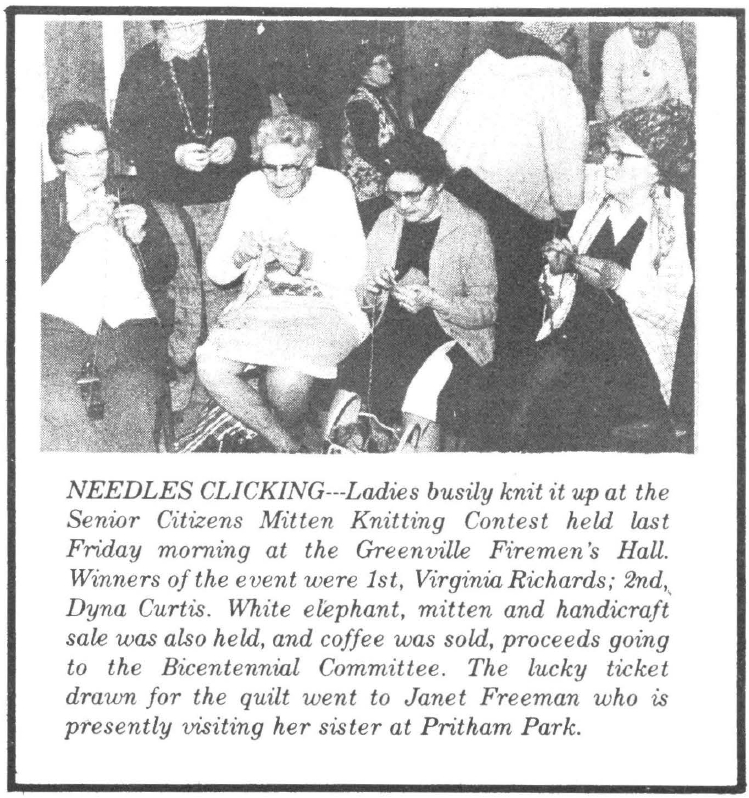
Across town, the Senior Citizens Club held a coffee and crafts sale at Firemen’s Hall, followed by a mitten‑knitting contest that produced warm results in more ways than one. Yarn was donated by Bartlett Yarns of Harmony, and the finished mittens were set aside for local schoolchildren. Virginia Richards took first place, with Dyna Curtis close behind — a small but meaningful reminder of how often community groups stepped in to help neighbors through the winter.
Outdoors, the festival was in full swing. Snowmobilers lined up for the Moosehead 100, a race that drew competitors from across the region. Only 12 of the 30 entrants managed to finish the grueling run. Racers left from behind the Indian Store, headed up the east shore of the lake to Ledge Island, crossed to Harford Point, dropped down to the Junction Wharf, and looped back to the start — ten‑mile legs run over and over until the hundred miles were complete.
Visibility was poor for part of the race, and most of the lake was glare ice. A thin layer of new snow hid rocks that slowed machines and damaged more than a few suspensions, but fortunately no one was hurt. Local riders Rick Higgins and Sheldon Smith each brought home a trophy.
Fast forward to today: on February 7, the Moosehead 100 returns, this time on Mountain View Pond just north of town. The sleds — and the speeds — will be a little different, but the spirit is the same.
The Moonlight Ride on Valentine’s Day brought dozens of sleds onto the trails under a bright, steady moon. A fishing derby offered prizes for lake trout, brook trout, salmon, and cusk, and the Winter Festival Parade — themed “Old Fashioned Greenville Winter” — made its way from Breton’s Store to the town office parking lot, with trophies waiting at the finish.
Today, the tradition continues in its own way. The 19th Annual Moosehead Lake Togue Derby runs February 6–8, 2026, with weigh stations in Greenville and Rockwood and a single‑fish bag limit for togue over 18 inches. The rules are stricter now, but the excitement is the same. By Sunday afternoon, the line at the scales still tells the story.
At Shadow Pond, the Key Club ran its toboggan races, bringing out students, parents, and plenty of laughter. The club had cleared the hill across from the Cabbage Patch down toward the pond, and the high school’s Winter Carnival added its own energy: tug of war, egg relays, three‑legged races, pie‑eating contests, and the crowning of the Winter Carnival King and Queen — Charlie Later and Sharon Larrabee, who later married and are still together. February was a month when the school felt like the center of town.
Tournament Time
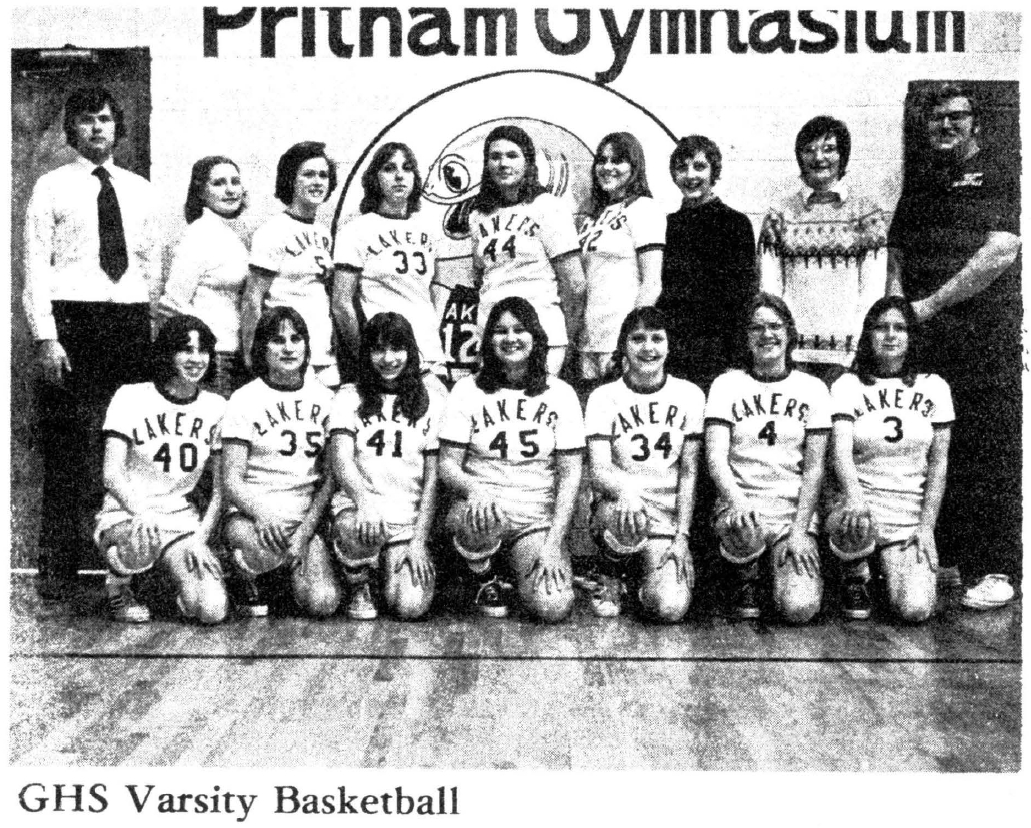
February also meant basketball tournament season, and in 1976 the Lakers were right in the mix. The boys’ team had a solid season but did not qualify for Bangor. The girls, however, finished third in Class D and earned a spot in the tournament — no small feat in an era when only four teams qualified.
They matched up with East Grand, fought hard, and came up short, but the roster — Judy Ryder, Jan Caron, Valerie Larrabee, and others — set the stage for what came next. Two years later, they were state champions.
For many families, those drives to the Auditorium were as much a part of winter as woodstoves and snowbanks. The names on those rosters still spark memories today, and the photos from that season — the uniforms, the hairstyles, the packed bleachers — remain some of the most cherished images in our local history. Tournament season still brings out that same feeling. Half a century later, people still check the brackets before they check the weather.
Skiing in an Olympic Winter
With the Olympics on television and winter sports in the spotlight, skiing was on everyone’s mind. Squaw Mountain was especially busy that winter, with full weekends and steady traffic on the slopes. Bud Leavitt wrote that the season “bordered on the edge of being delicious,” with sunshine, cold air, and a moon that seemed to shine just for Greenville.
The high school ski team was active that winter too, training on the mountain and competing across the region. Their yearbook photos — the smiles, the snow, the easy confidence of teenagers who lived outdoors — capture a moment when skiing felt like the heartbeat of winter life.
And just beyond the school roster, three local brothers were making waves of their own. Chip, Tris, and Erik Cochrane of Greenville had been racing for five years, and by February all three had earned spots on the NARA Maine State Ski Team. They trained independently, raced in downhill, slalom, and giant slalom, and were starting to turn heads across the region. Chip, age 15, had placed third overall in a senior competition at Sugarloaf. Tris, just 13, was headed to the Eastern Regionals. Erik, 11, had cracked the top 15 in his class and was one of only three boys statewide to qualify for Regionals.
They were weekend skiers with no formal coaching — just grit, drive, and a love of the mountain. They also skied for the school as part of a club team, with their father Warren Cochrane, a science teacher at Greenville High School, serving as advisor. Their rise was one more reminder of how deeply skiing ran through the community that winter.
Civic Concerns and Community Stewardship
Not everything in February 1976 was festive. The Moosehead Sanitary District was facing serious challenges. Treasurer John Ryder resigned in protest, citing concerns about the wastewater treatment plant’s performance and the burden it placed on the town. The Protect Moosehead Lake Association was active as well, raising funds and pressing for stricter oversight. It was a tense moment, and a reminder that protecting the lake has always required vigilance.
At the same time, Greenville was wrestling with its future. A public hearing on the town’s comprehensive plan highlighted concerns about population decline and economic stagnation. Residents debated how to attract new businesses, support young families, and keep the town self‑sufficient. Those questions haven’t gone away. Greenville updated its comprehensive plan last summer, and many of the same themes — growth, housing, opportunity — are still on the table.
There were bright spots too. In February 1976, Richard Kennedy of Greenville was appointed to the board of the Penobscot Piscataquis Chapter of the American Red Cross — the first Piscataquis County resident to serve. Today, his daughter Mildred sits on the board of the Moosehead Historical Society, a quiet thread of continuity that speaks to the way community leadership often passes from one generation to the next.
Looking Back, Looking Forward
Looking back at February 1976, you see a month full of motion: winter festivals, school spirit, civic debates, and the steady rhythm of a community deep in winter. You see a town that gathered in the cold, argued when it needed to, celebrated when it could, and kept an eye on the lake that shaped its life.
One small note from today adds a bit of symmetry: Barry Manilow has announced he’s adding Maine to his 2026 tour — and says it will be his final performance in the state. Not everything from 1976 circles back, but every now and then, something does.
Bud Leavitt wrote that winter in Greenville that year rivaled the “good old days,” and maybe that’s the best way to think about it. Every generation has its own version of winter joy, winter worry, and winter pride. The names change, the buildings change, but the rhythm of the place — the way Moosehead comes together in February — remains much the same.
Next month, we’ll look back at March 1976 — a stretch that brought municipal elections, school sports awards, and more hard conversations about the future of the sanitary district. It was a month when winter began to loosen its grip, but the work of the town was just getting started.
This column is brought to you by the Moosehead Historical Society, where every season brings new stories to uncover, preserve, and share. From ski trails to supper tables, we’re here to keep Moosehead’s history alive — one memory at a time. You can support our work by becoming a member at mooseheadhistory.org.