Moosehead Then & Now: January 1976
January 1976 opened with the country looking ahead. Gerald Ford was in the White House, Jimmy Carter had just surprised the political world by winning the Iowa Democratic Caucus, and on the radio Barry Manilow’s “I Write the Songs” was climbing toward number one. Happy Days was one of the most‑watched shows on television, and gas hovered just above 59 cents a gallon. It was the Bicentennial year, and Americans were thinking about where they’d been and where they were going — a feeling that echoed here in Moosehead as winter settled in.
The new year arrived in Greenville with a little extra energy. Fourteen couples gathered at Leisure Life Lanes for a New Year’s Eve party that mixed bowling, music, and sore shoulders. Over 473 strings were bowled in one night — moonlight bowling, “one ball,” “headpin,” and “odd pins” kept things lively — and more than $100 in prizes were handed out. After 17 strings apiece, some folks were moving a little slower on New Year’s Day, but the celebration was worth it. If you were one of those bowlers, we’d love to hear from you. These are the kinds of stories that bring local history to life — not just the numbers, but the people behind them.
Community Notes and Local News
Community organizations kept their usual pace, even in the heart of winter. The Union Church Council met to plan improvements, including a speaker system to be installed in memory of Dick and Bernice Young. The Ready Workers Society and the Laura Davison Missionary Society both held their annual meetings, elected officers, and set plans for the months ahead. The Hospital Auxiliary also elected new officers and discussed purchasing a portable medical monitor for both the hospital and the ambulance — another example of how often local groups stepped in to support community needs.
The Greenville Police Department had its hands full as well. On January 16 or 17, someone broke into Jardine’s Small Motor Repair Shop on Lakeview Street and stole roughly $4,500 worth of snowmobile and outboard parts — drive‑belts, propellers, ignition parts, and Moto‑Ski covers among them. Officer Bud Pelletier asked residents to report anything suspicious and reminded folks to keep their dogs tied up. It was a serious loss for a local business, and the kind of case that pulled the whole community into keeping an eye out.
A Tribute to Doc Nick
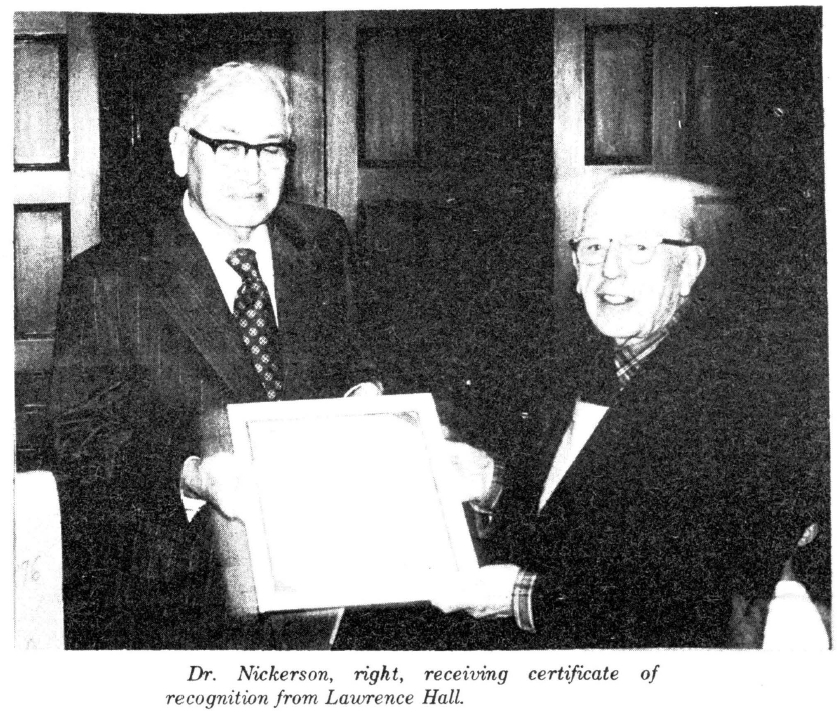
One of the most meaningful moments of the month came on January 18, when the town gathered at the Union Evangelical Church to honor Dr. Norman “Doc” Nickerson for more than fifty years of service in family medicine. Practicing here since 1919, Doc Nick delivered generations of children, made countless house calls, and cared for families across the region with a steady, reassuring presence. Scrapbooks were opened, stories were shared, and the Selectmen presented him with a key to the community — a simple gesture that carried the weight of decades of gratitude.
That same week, the Greenville Housing Corporation announced the purchase of a 2½‑acre parcel of Dr. Nickerson’s land on Pritham Avenue, offered at a price so low it amounted to a gift. With support from the Lakeview Women’s Club and the Kiwanis, the land was set aside for walking, gardening, and picnicking — a new space for the residents of Pritham Park. It was a quiet act of generosity, entirely in keeping with the man the town was honoring.
Eight years later, in January 1984, that gift took on new life when the land officially opened as Nickerson Park, home to sixteen apartments for residents aged sixty‑two and older. Nickerson Park remains today — well‑kept, well‑loved, and with a waiting list that speaks to the need it continues to meet. It stands as a living extension of Doc Nick’s lifelong work: a place built for comfort, dignity, and community, created on land he quietly made possible.
And for many of us, whenever we drive past what is now the Eurich Insurance building, we’re taken right back to the days of stepping into Doc Nickerson’s office — the waiting room, the familiar smell, the steady presence of a man who cared for this town for more than sixty years. His house next door, now Moose Country Real Estate, carries that same echo. The buildings have changed hands, but the memory of who worked there — and what he meant to Greenville — still lingers.
Snowmobiles at the Airport
January also brought the roar of engines to the Greenville Airport, where the Fifth Annual New England Open Snowmobile Championships were held in bitter cold. Temperatures hovered below zero, and roughly 300 people bundled up each day to watch some of the top racers in the East compete on the half‑mile oval. Local racers Colen Arey, Rick Higgins, and Peter Cyr took their shot, though the out‑of‑state competition was fierce. With $6,500 in prize money, the weekend felt like a major winter event — the kind that made Greenville the center of attention for a few frozen days. Hard to imagine using the airport for something like that now, but in 1976 it was the loudest place in town.
A Busy Month on the Mountain
Squaw Mountain was in full swing that January. More than 20,000 skiers had already visited the slopes that season, and the mountain was gearing up for a Freestyle Ski Meet on January 24. Weekend dances, buffets, and live music filled the chalet, with bands playing well into the night. Even the ski racks were under watch: officers kept an eye on equipment, and only five pairs of skis had gone missing all season — a small miracle given the crowds.
The mountain felt like the center of winter life, drawing college students, families, and young racers alike. It was a place where the community mixed easily, where the cold didn’t matter much, and where the Bicentennial year felt full of possibility.
Two New Hair Businesses Open Their Doors
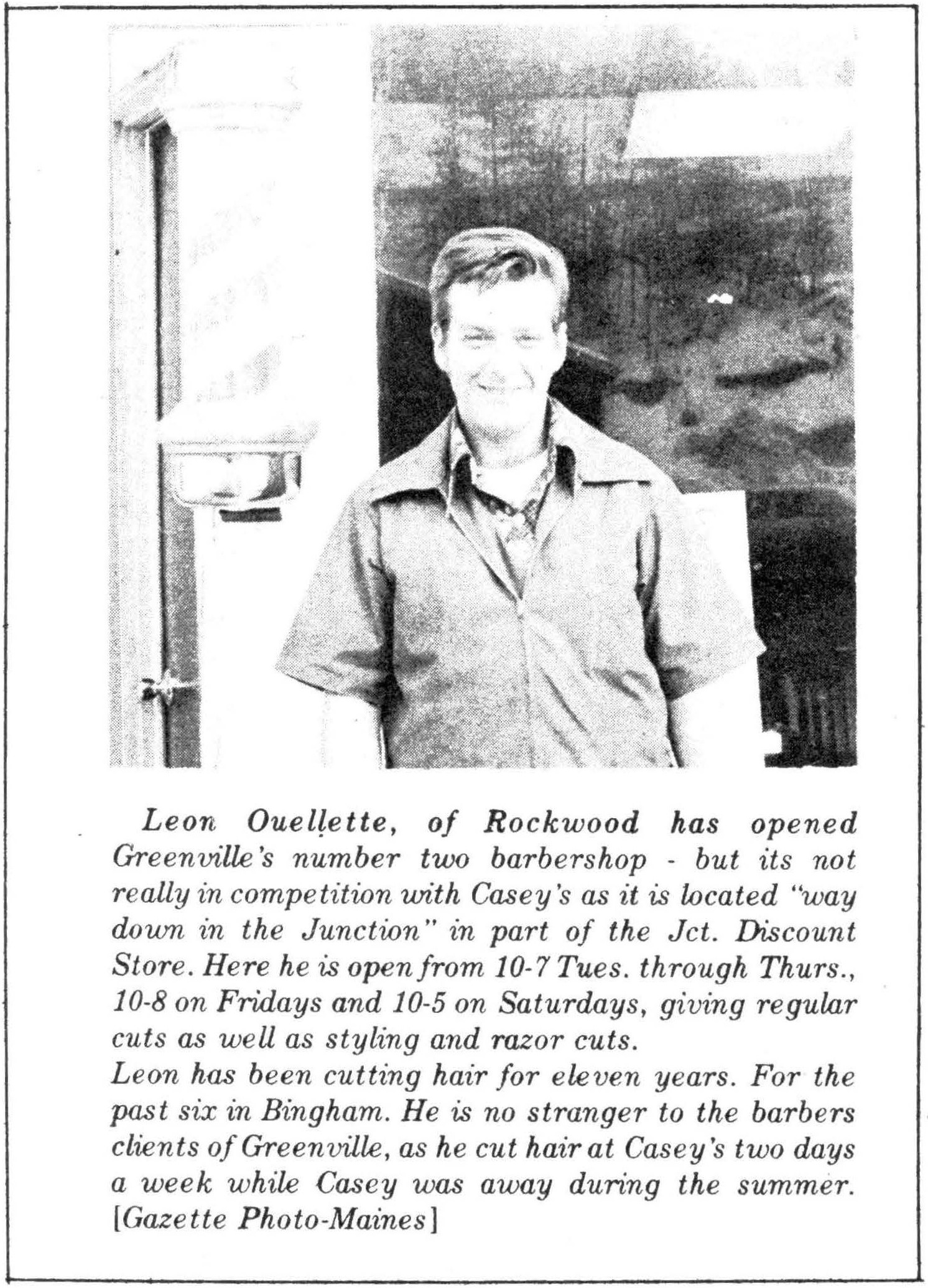
January 1976 also saw the opening of two new hair businesses in town. In the Junction, Leon Ouellette of Rockwood opened Greenville’s second barbershop inside the Junction Discount Store — right across the street from what’s now Breton’s. He offered regular cuts, styling, and razor work, keeping hours that suited working folks and bringing more choice to the community.
Across town, Ellen Colgan opened Hair Horizons on South Main Street, welcoming her first customer, Linda Morrill, in a warm, wood‑paneled space. The shop was located in the former Indian Hill Farm Dairy, which had closed in 1970. Today, that same building is home to Studio North, owned and operated by Karen Carpenter Peat for more than three decades — a quiet continuity that links past and present.
Looking Back, Looking Forward
Looking back at January 1976, you can see the threads that still run through the Moosehead region today: winter sports, strong local businesses, active community groups, and the steady hum of neighbors keeping track of one another. Some of the names have changed, and some of the buildings have new owners, but the rhythm of the place — the way the community comes together in the heart of winter — remains much the same. In a Bicentennial year that encouraged Americans to look backward and forward at once, Moosehead did what it has always done: it kept moving, kept gathering, and kept building the kind of community that endures.
Next month, we’ll look back at February 1976 — a month that brought an Olympic skier to Squaw Mountain, the grueling Moosehead 100, Greenville High School’s Winter Carnival, and the Lakers closing out their basketball season.
This column is brought to you by the Moosehead Historical Society, where every season brings new stories to uncover, preserve, and share. From ski trails to supper tables, we’re here to keep Moosehead’s history alive — one memory at a time. You can support our work by becoming a member at mooseheadhistory.org.