Moosehead Then & Now: June 1976
June 1976 arrived with the country deep into a restless election year. Gerald Ford and Ronald Reagan were locked in one of the closest Republican primary fights in modern memory, and Jimmy Carter was steadily pulling away on the Democratic side. America was just weeks from its 200th birthday, and the air was full of flags and anticipation. On the radio, Wings’ “Silly Love Songs” had been sitting at number one for most of the month, and the Ford-Reagan showdown was the story everyone was following. Here in Greenville, June meant something more immediate: graduation, the end of another school year, and the slow, steady hum of a community getting ready to mark something big.
A Class Steps Forward
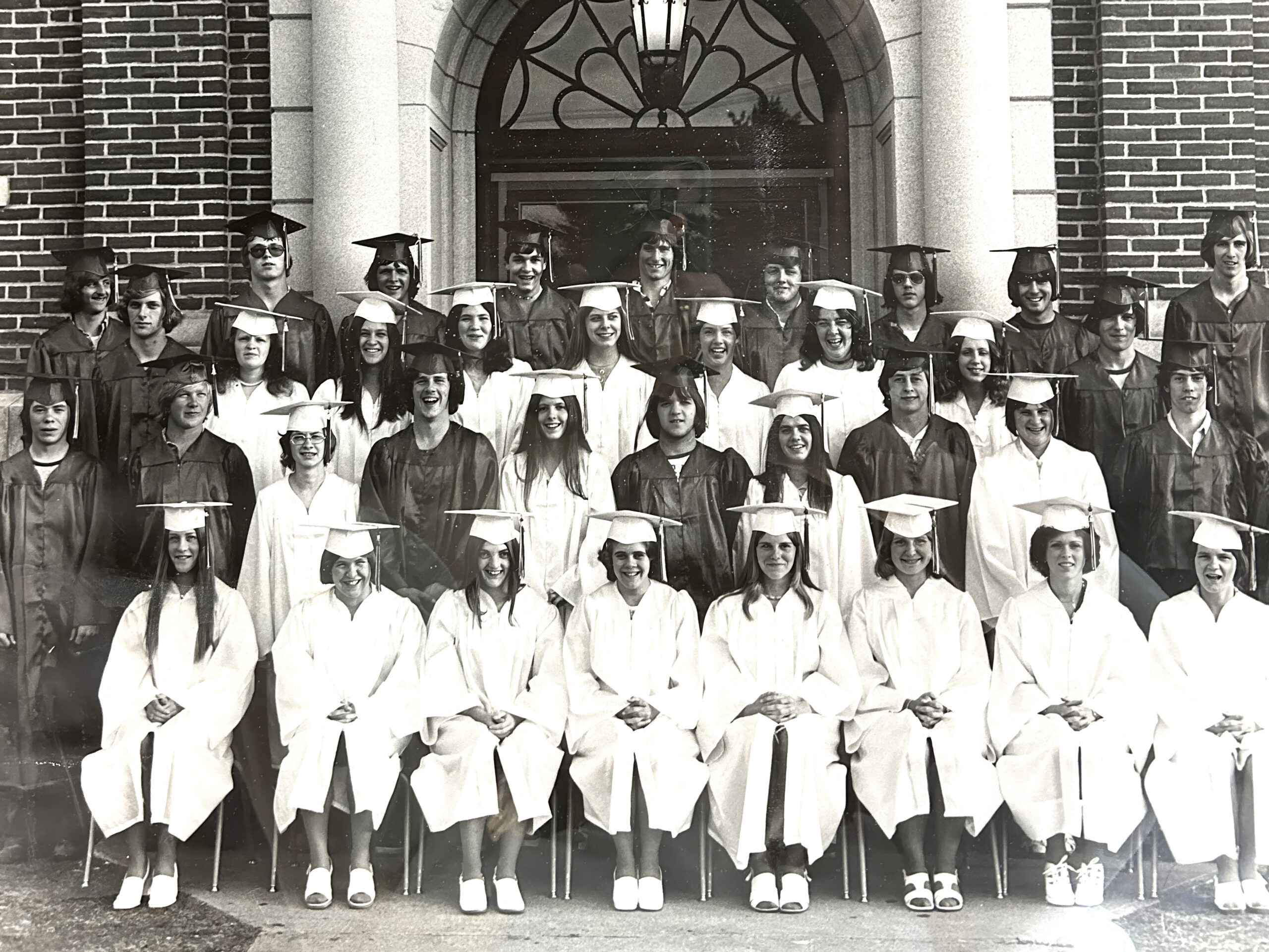
On June 10, the Greenville High School Class of 1976 gathered in front of the Greenville Consolidated School in their caps and gowns for a photograph that ran on the front page of the Moosehead Gazette. There were 41 of them — a packed auditorium, a full row of names on the program. Valedictorian Woodie Bartley, heading to the University of Southern Maine, told his classmates that the Bicentennial year was the perfect moment “to stop, take a look, and see if we are heading in the right direction.” Salutatorian Julie Irvine called them “a special people bound together by that certain American spirit.” The names on that roster — Bartley, Ryder, Folsom, Gilbert, Nye — are names still woven through this community today.
Fast forward to 2026. On Sunday, June 7, Greenville High School will hold its commencement ceremonies in the same auditorium. The graduating class numbers eight. The entire high school has roughly 40 students. The ceremony will be no less meaningful for its size — if anything, more so. Every name matters more when there are fewer of them. Every family in that auditorium will know every other family. That’s not a diminishment of what Greenville is. It’s simply what Greenville is.
Two Retirements Worth Remembering
The graduation season brought two retirements that said something about the depth of commitment this community inspires in the people who serve it.
Charlotte Folsom had spent 34 years in the classroom, 14 of them at Greenville High School, teaching reading to every student who came through the Junior High — and some of their parents as well. On June 9 her students sent her off with a rocking chair cake and a hanging fuchsia plant. She had been a counselor and advisor too, the kind of teacher who showed up in more ways than one. She wasn’t entirely done — she planned to keep tutoring, and to fix up the family farm on the lake above Kineo Island. That is a Greenville retirement.
Not long after graduation, Frank Tarazewich announced he would be leaving as principal after ten years. He came to Greenville originally to coach football and teach physical education — a Marine, a University of Maine graduate, a man who had played semi-pro ball with the Portland Seahawks in 1965. He became principal, joined the Kiwanis, led a Boy Scout troop, and gave this community a decade of steady, committed leadership.
What many people here may not know is what he went on to build after leaving. He joined SAD 57 in southern Maine and spent the next 22 years there — longer than he was in Greenville. The district thought enough of his contribution to name a gymnasium after him, a recognition that speaks for itself. Frank Tarazewich passed away in 2006. His daughter, Kelly MacFadyen, is today the superintendent of Greenville Consolidated School, the school her father once led. There is no clearer example of the way Greenville leaves its mark on the people who served it — and the way those people leave their mark in return.
Last Summer for the Katahdin?
That was the headline in the July 2 Gazette, and it asked a question the whole town was quietly sitting with. The Kate had been on Moosehead since 1914, carrying passengers to Mount Kineo, Rockwood, and Seboomook — if a stop wanted the boat to come in, they ran up a flag. By the 1930s she had been sold to Scott Paper and spent decades hauling log booms. In 1975, Scott ran its last river drive. Now the Kate was doing salvage work, slow and not profitable, and showing every year of her age. Captain Walter Gary was blunt: “The wood is rotting. We could paint it three times a year and it would still peel off.” It was understood that this might be the last season.
We came very close to losing her. A group of local citizens refused to let that happen. They founded the Moosehead Marine Museum in 1977, got the Kate listed on the National Register of Historic Places in 1979, and brought her back to the water. In 1998 Louis O. Hilton leased the museum land to the organization; in 2010 he gifted it outright.
Today the Katahdin is one of Greenville’s great living treasures — a working piece of history that still draws people to Moosehead every season. The Moosehead Marine Museum opens this month. If you haven’t been out on her in a while, there is no better time. The view of Mount Kineo from the water hasn’t changed in over a century.
A Town Getting Ready
The rest of June 1976 had the feel of a community drawing a breath before something big. The Bicentennial was just weeks away. The Moosehead Bicentennial Committee had a full day of events scheduled for July 5 — a parade down Pritham Avenue, field events at the high school, a boat regatta in the village cove, a public supper put on by the Key Club, fireworks from the Junction Wharf, and a dance in the gym afterward. Twenty floats had already registered for the parade. The Lakeview Women’s Club had planted two flower beds — one at the Triangle near the Mini-Pit Stop, one on the hospital lawn — red, white and blue flowers meant to depict the American flag when they came into bloom. A community choir of thirty voices from Greenville, Shirley, Rockwood and Beaver Cove was rehearsing a patriotic cantata for July 4.
Ralph and Helen Webber, after eleven years running the Western Auto store on Main Street, quietly announced their retirement. They weren’t going to Florida. “We live here,” Helen said. “This is our home.” Ralph planned to go fishing. Helen planned to clean up what had been piling up for eleven years. It was that kind of June.
Up in Rockwood, Wayne Hockmeyer and Alan Haley were quietly launching something new — daily guided whitewater raft trips down 23 miles of the upper Kennebec, one of the roughest stretches of river in the East. It was the first time those waters had been used recreationally, and Hockmeyer didn’t undersell the experience: “Anyone who tried it in a canoe would most likely be killed.” The region was changing, and the old working waters were beginning to find new uses.
The Ready Workers Society tried something new that June — a Father’s Day Buffet at the Community House. They weren’t sure what to expect. What they got was 167 people showing up for the noon meal, going back for seconds, and complimenting the food so enthusiastically that the committee had to stop selling tickets at 1 o’clock. They turned people away in the last hour and promised it wouldn’t happen again. The prize for oldest father in attendance went to Orville Harvey; youngest father went to Bruce Fowle. That is a Greenville Father’s Day.
The Greenville Police Beat that month offered a few reminders of simpler times. Chief Bud Pelletier, back from the Maine Police Chiefs Conference in Bath, had strong views on the state’s newly liberalized marijuana laws and stronger views on who was to blame: “The biggest lobbyist that supports drugs in the U.S. is Playboy magazine.” Meanwhile, a two-car accident at Main and Cottage Streets involved Debra Pelletier, Laura Pelletier, and was investigated by Officer Bud Pelletier. None of the three Pelletiers, the Gazette noted carefully, are related.
The sewer fight ground on. One hundred residents packed Firemen’s Hall on June 21 to hear the Sanitary District board explain a situation that was growing harder to explain — a $4 million plant that had just broken down over the weekend, couldn’t get a discharge permit from LURC to continue sending effluent into Moosehead Lake, couldn’t pay its bills, and was inching toward bankruptcy. Chairman Hubbard Trefts had spent two days trying to reach Senator Muskie in Washington. The lake was the whole point. And the fight wasn’t over.
Looking Back, Looking Forward
Next month we’ll look back at July 1976 — the Bicentennial celebration itself, fireworks over the Junction Wharf, Rockwood’s contests at the Kineo docks, and a town still wrestling with sewer, planning, tourism, and growth in the year America turned 200.
This column is brought to you by the Moosehead Historical Society, where every season brings new stories to uncover, preserve, and share. We’re here to keep Moosehead’s history alive — one memory at a time. You can support our work by becoming a member at mooseheadhistory.org.
Saluting the Class of 1976
Row 1: Mary Leighton, Vicki Harris, Rhonda Haggan, Cindy Gould, Tracy Walden, Julie Irvine, Karen Johnson, Sharon Larabee; Row 2: Mike Morin, Rodney Folsom, Lilly Adkins, Lee Young, Dorene Audette, Peter Gravelle, Denise Gagne, Jack King, Heidi Wortman, Kirby Murray; Row 3: Charlie Later, Juanita Salisbury, Mary Richards, Stefanie Poulson, Carla Huff, Mary Nye, Sue Cartwright, Jane Ashe, Donnie Martel; Row 4: Randy Pullyard, Steve Copeland, Kendall Ryder, Tunney King, Woody Bartley, Henry Gilbert, Dennis Lavigne, Mike Ward; Missing from photo: Saundra Bowker, Heather Hicks, Isobel Horn, Margaret Munster, Audrey White.
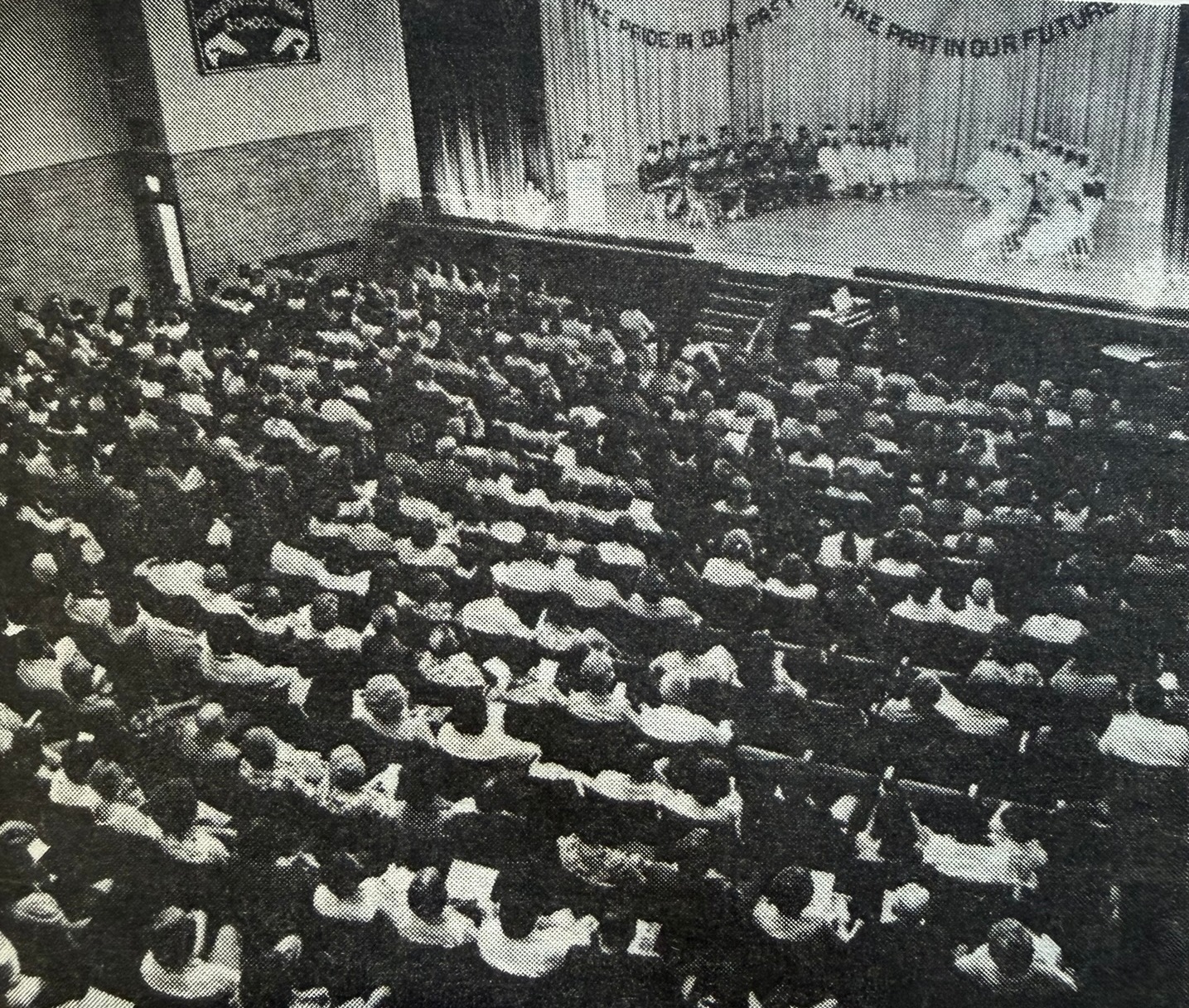
Graduation exercises at the Greenville High School auditorium, June 1976. The Class of 1976 filled the stage, and the auditorium was packed with families, friends, teachers, and neighbors gathered to send them forward.
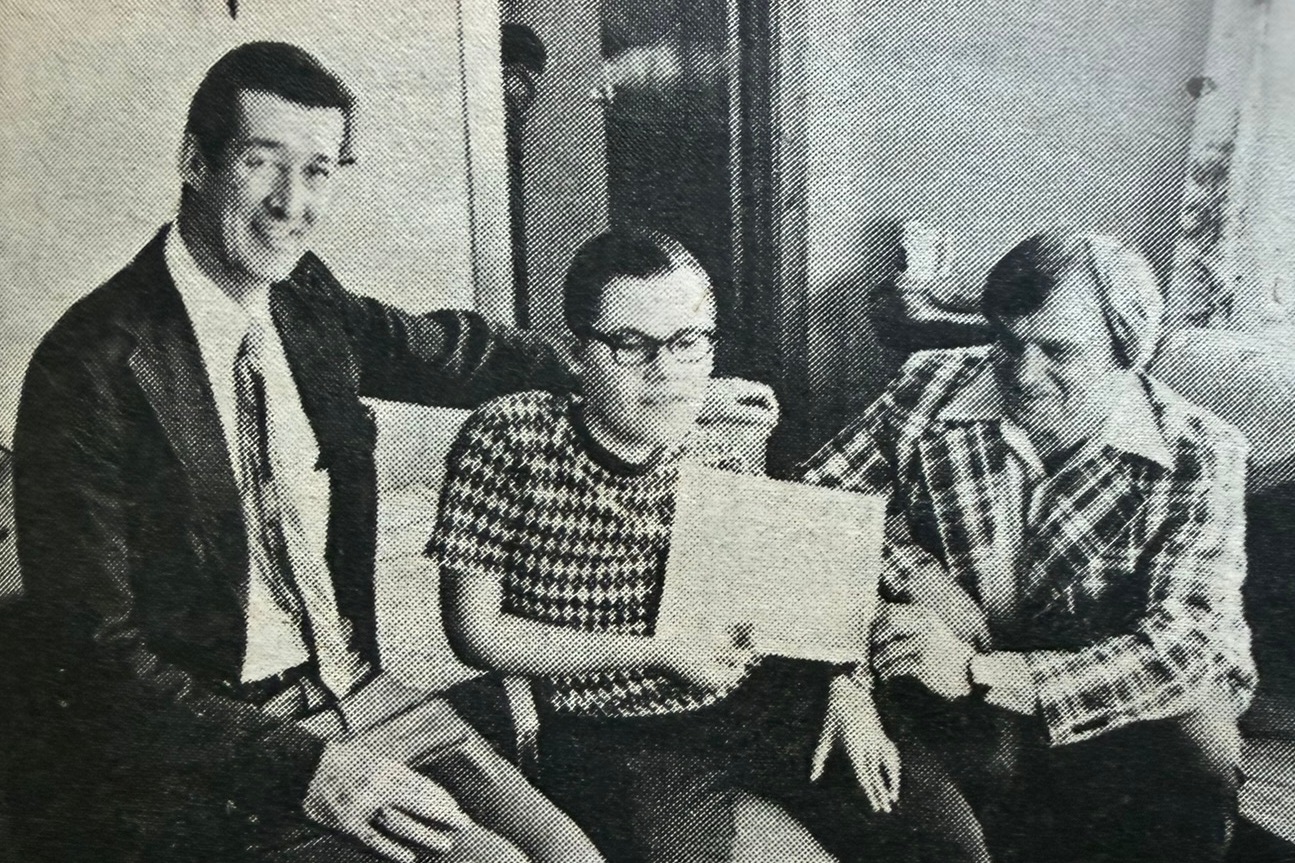
Principal Frank Tarazewich, right, with Steven Macomber and SAD #2 Superintendent Ralph Ryder in June 1976. Macomber, unable to attend the awards banquet, received his certificate of achievement for high honors at home.
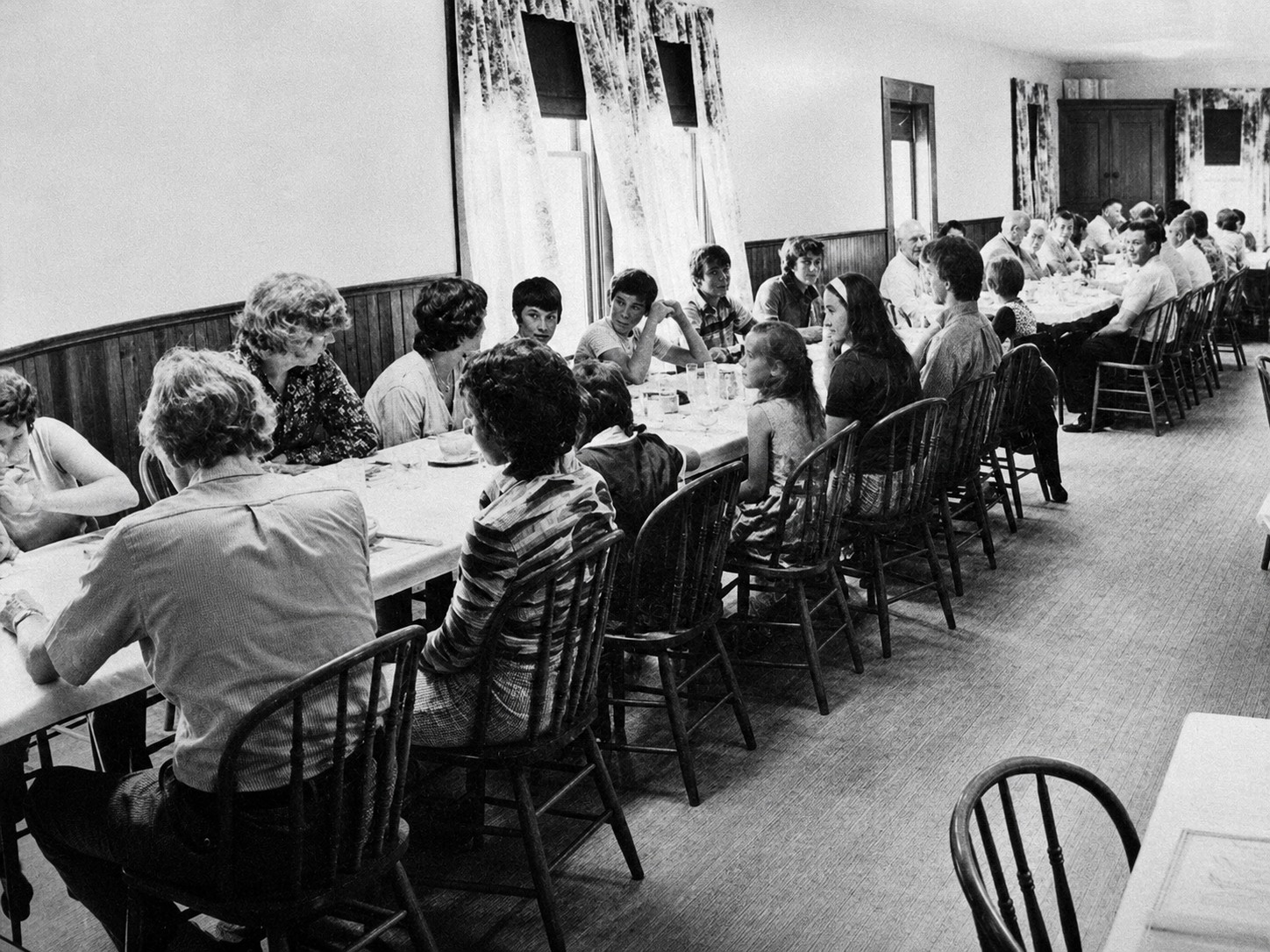
The Ready Workers’ Father’s Day Buffet filled the Community House in June 1976, drawing 167 people for a noon meal that proved more popular than anyone expected.