Remembering Richard Francis Lavigne’s Sacrifice
There is a bridge on Route 15, about ten miles north of Greenville, roughly halfway between Greenville and Rockwood, that most of us cross without giving it much thought. It spans the East Outlet of Moosehead Lake, and if you blink you’ll miss the sign. It reads: Richard Francis Lavigne Memorial Bridge.
Most people don’t know the name. They should.
Francis Lavigne grew up in Greenville, the son of Richard and Ursula Lavigne. He graduated from Greenville Consolidated School in 1940, one of those young men you’d see around town — at church, at the lake, just around. In November of that year, at nineteen years old, he enlisted in the Army Air Corps. He trained as a tail gunner on a B-17 at Savannah Air Base in Georgia, earned his technician’s diploma at Lory Field in Denver, and in November 1941 shipped out to the Philippines.
He was twenty years old.
What happened next is part of one of the darkest chapters of the Second World War. When the Japanese attacked the Philippines in December 1941, American forces were overwhelmed and pushed onto the Bataan Peninsula. Francis was wounded on December 13th. By April 1942, Bataan had fallen. He was taken prisoner.
Back in Greenville, his mother Ursula knew almost nothing. The last word she’d had from her son was before November 6, 1941, when he was about to leave Honolulu. Then silence. Every morning she rose before dawn and delivered 63 newspapers around town. She knitted for the Red Cross. She waited. That’s what the mothers did.
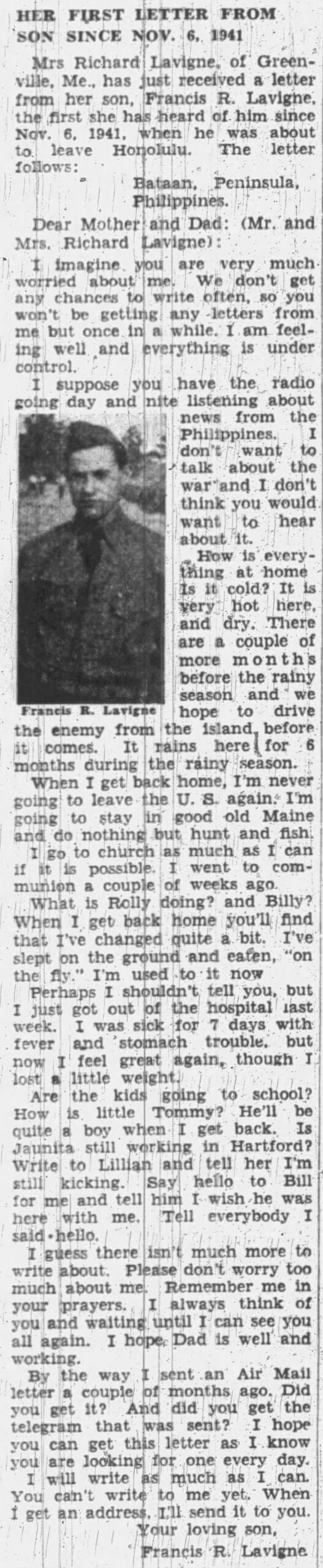
Then in August 1942, a letter arrived. It had been written from Bataan months earlier and had only now found its way home. His mother sent it to the Bangor Daily News, which published it in full as part of a regular wartime column — neighbors sharing news of their sons and daughters in service with anyone who cared to read. Reading it today, more than eighty years later, it is almost unbearable.
He told his parents not to worry. He said the mail was unreliable and they shouldn’t expect to hear from him often. He asked about people back home — Rolly, Billy, Juanita, young Tommy. He mentioned he’d been in the hospital for seven days with fever and stomach trouble but felt fine now. He said hello to everyone.
And then, in the middle of this careful, steady letter written by a young man who clearly did not want to frighten his parents, he let something through.
“When I get back home, I’m never going to leave the U.S. again. I’m going to stay in good old Maine and do nothing but hunt and fish.”
He never came home. The family learned he had been reported missing after the fall of Bataan. Three years passed before the War Department confirmed what they had feared. In July 1945, memorial services were held at Holy Family Catholic Church — a service without a body, for a boy who was still somewhere on the other side of the world.
His family waited four more years after that. It was not until the fall of 1949 that his body was finally returned to the United States aboard the ship Joseph Merrill and escorted to Greenville by Sgt. Bruno Palionis. Full military honors were accorded by the Cecil R. Cole American Legion Post. The Rev. David P. Surette officiated at Holy Family Catholic Church. The young men who had grown up alongside Francis served as his bearers. He was the first Greenville man to die in the service of his country in World War II. It had taken seven years to bring him home.
Seventeen years later, in January 1959, his younger brother Tom walked into a recruiting office and enlisted in the same Army. He was photographed with six other Greenville boys, all enlisting together under the buddy plan. Tom Lavigne still lives in Greenville today.
A July 1943 issue of the Bangor Daily News ran a full page of photographs of Greenville men and women in service. Dozens of faces, row after row. Francis is among them. So is his mother, mentioned in a caption — still delivering papers, still knitting, still going.
This Memorial Day, if you find yourself on Route 15 heading north out of town, slow down a little when you get to the East Outlet. The bridge is named for a twenty-one-year-old boy who trained hard, served faithfully, endured what few of us can imagine, and died far from the lakes and woods he loved.
He just wanted to come home to Maine.